 Plain Lantern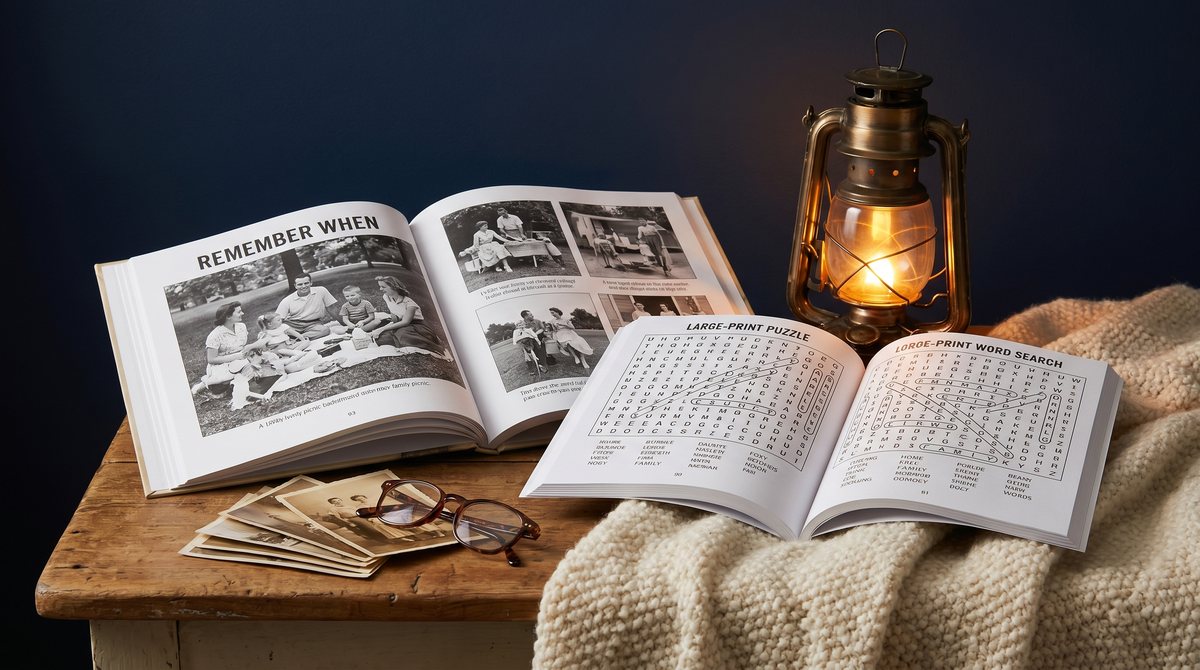
Choosing a book for a parent, partner, or grandparent living with dementia is a small, loving job, and the right pick really can make a difference. A good match can fill a calm hour, turn up a happy memory, or just give two people something easy to share. A poor one tends to cause quiet frustration. The reassuring part is that the things that make a book dementia-friendly are easy to spot once you know what you are looking for.
How dementia changes the way we read
Dementia affects short-term memory, attention, and how quickly the brain takes information in. A long novel asks a reader to hold a plot, a crowd of characters, and last night's chapter all at once, and that slowly becomes hard and tiring. Plenty of other reading still gives real pleasure, though. Older memories and emotional ones often stay clear long after recent ones blur, which is why a familiar song, an old photo, or a childhood story can still light someone up. You are not trying to test anyone. You are offering a bit of comfort and the pleasure of recognising something.
What makes a book dementia-friendly
Whatever the subject, the best books for seniors with dementia tend to share the same handful of qualities:
- Large, clear print with strong contrast. Easier on aging eyes, and on a mind that tires and loses its place.
- Simple, uncluttered pages. One idea or one image at a time, with room to breathe.
- Short, self-contained pieces. A single puzzle, a one-page story, a photo with a caption. Nothing to remember from before, and an easy place to stop.
- Familiar, nostalgic themes, the sort rooted in long-term memory: home, music, nature, faith, the old days.
- No way to "fail." No score, no clock, nothing that can feel like a wrong answer.
The best kinds of books for seniors with dementia
Large-print word search and simple puzzle books
Gentle word searches are a quiet favourite, and it is easy to see why. They give a real sense of having finished something, but they lean on memory not at all, and a person can do one word or twenty. Look for very large grids, bold letters, and easy, familiar word lists instead of clever themes.
Nostalgia and reminiscence books
Books built around memories make wonderful conversation starters: decades of music, old advertisements, ordinary life from years back. Dementia organisations call this kind of gentle prompting reminiscence, and it works by leaning on the long-term memory that tends to stay strong, drawing out stories and settling the mood.
Picture and photography books for adults
When the words get hard, pictures still carry plenty. Grown-up picture books of landscapes, animals, gardens, or familiar places can be opened anywhere and enjoyed for as long or as little as suits the moment. There is nothing to keep up with.
Familiar faith books, hymns, and devotionals
For someone with a lifetime of faith, well-worn verses, prayers, and hymns sit deep and tend to comfort. Large-print devotionals and simple scripture activity books, laid out plainly, can give both reassurance and the steadiness of a familiar routine.
Short stories, poems, and old favourites
A short story or a poem can be read and enjoyed in one sitting, then read again next week with the same pleasure. Childhood rhymes and old classics often raise a smile for the simple reason that they are so well known.
What to gently avoid
- Dense novels and small print. Long, twisting stories and cramped text turn tiring fast.
- Anything that feels like a test. Quizzes, timers, and scores tend to create anxiety where there was none.
- Childish or talking-down content. Keep it simple but still grown-up. Simple is not the same as treating an adult like a child, and the difference shows.
Reading together: a few gentle tips
The book is often just the doorway. The shared time is the real gift. Read aloud if it helps, and let the other person set the pace. Try not to quiz or correct. If a memory comes out a little differently each time, let it. Repetition here is a comfort rather than a problem, so a favourite can be opened again and again. Follow their lead, too. If one photograph holds their attention for ten minutes, that is a good ten minutes.
A book that meets them where they are
The best book for a senior with dementia is the one that fits the person in front of you today: readable, familiar, unhurried, and impossible to get wrong. Large print, clear pages, and familiar subjects do most of that work.
Plain Lantern Press makes books with exactly this in mind: large, readable type, uncluttered pages, and calm, familiar subjects. If you are choosing for someone you love, you can browse the Plain Lantern library for a title that feels gentle, keeps a person's dignity, and is easy to enjoy together.